


What are the manufacturing processes of PET Geogrid?
As a supplier of PET Geogrid, I am excited to share with you the detailed manufacturing processes of this remarkable product. PET Geogrid, made from Polyethylene Terephthalate (PET), is widely used in civil engineering for soil reinforcement, road construction, and retaining wall applications due to its high strength, durability, and excellent chemical resistance.
Raw Material Selection
The first step in the manufacturing process of PET Geogrid is the careful selection of raw materials. High - quality PET resin is the primary ingredient. The PET resin should have consistent properties, such as a specific molecular weight and melting point. This ensures that the final geogrid product will have the desired mechanical and physical characteristics.
We source our PET resin from trusted suppliers who adhere to strict quality control standards. The resin is typically in the form of small pellets, which are easy to handle and process. Before use, the pellets are thoroughly inspected to ensure they are free from impurities, moisture, and any other contaminants that could affect the quality of the geogrid.
Extrusion
Once the raw materials are selected, the next step is extrusion. In this process, the PET pellets are fed into an extruder. The extruder consists of a heated barrel with a rotating screw inside. As the screw rotates, it transports the PET pellets along the barrel, and the heat from the barrel melts the pellets into a molten state.
The molten PET is then forced through a specially designed die. The die has a grid - like pattern, which gives the geogrid its characteristic shape. The extrusion process requires precise control of temperature, pressure, and screw speed to ensure that the molten PET flows evenly through the die and forms a uniform grid structure.
During extrusion, additives can be incorporated into the molten PET to enhance the properties of the geogrid. For example, UV stabilizers can be added to improve the geogrid's resistance to sunlight, and flame retardants can be added to increase its fire - resistance.
Stretching
After extrusion, the newly formed PET geogrid is in a relatively weak and amorphous state. To improve its strength and stiffness, the geogrid undergoes a stretching process. Stretching aligns the polymer chains in the PET, which significantly enhances the mechanical properties of the geogrid.
There are two main types of stretching: uniaxial and biaxial. Uniaxial stretching involves stretching the geogrid in one direction, typically along its length. This results in a geogrid with high strength in the stretched direction and relatively lower strength in the perpendicular direction. Uniaxial geogrids are commonly used in applications where reinforcement is required in a single direction, such as in soil reinforcement for embankments. You can learn more about Polyester Uniaxial Geogrid.
Biaxial stretching, on the other hand, involves stretching the geogrid in two perpendicular directions. This creates a geogrid with high strength in both directions, making it suitable for applications where multi - directional reinforcement is needed, such as in road construction.
The stretching process is carried out at a controlled temperature, usually above the glass transition temperature of PET but below its melting point. This allows the polymer chains to move and align more easily during stretching. The stretching ratio, which is the ratio of the final length to the initial length of the geogrid, is carefully controlled to achieve the desired mechanical properties.
Surface Treatment
After stretching, the PET geogrid may undergo a surface treatment process. Surface treatment can improve the geogrid's adhesion to soil, asphalt, or other construction materials. One common surface treatment method is coating.
For example, a PVC coating can be applied to the geogrid. PVC - coated polyester geogrids offer enhanced chemical resistance, abrasion resistance, and UV protection. The PVC coating also provides a smooth surface, which can reduce friction between the geogrid and other materials during installation. You can find more information about PVC Coated Polyester Geogrid.
Another surface treatment method is embossing. Embossing creates a textured surface on the geogrid, which can improve its interlock with soil particles and enhance its reinforcement effect.
Quality Control
Throughout the manufacturing process, strict quality control measures are implemented to ensure that the PET geogrid meets the required standards. Quality control starts with the inspection of raw materials and continues through each stage of the manufacturing process.
During extrusion, the thickness and width of the geogrid are continuously monitored to ensure they are within the specified tolerances. Samples are taken at regular intervals and tested for physical and mechanical properties, such as tensile strength, elongation at break, and aperture size.
After stretching, the geogrid is again tested to verify that its strength and stiffness have been improved as expected. The surface treatment process is also carefully monitored to ensure that the coating or embossing is uniform and of high quality.
Applications of PET Geogrid
PET Geogrid has a wide range of applications in civil engineering. One of the most common applications is in soil reinforcement. When installed in soil, the geogrid provides additional support and stability, reducing the risk of soil erosion and slope failure. It can be used in embankments, retaining walls, and foundation reinforcement.
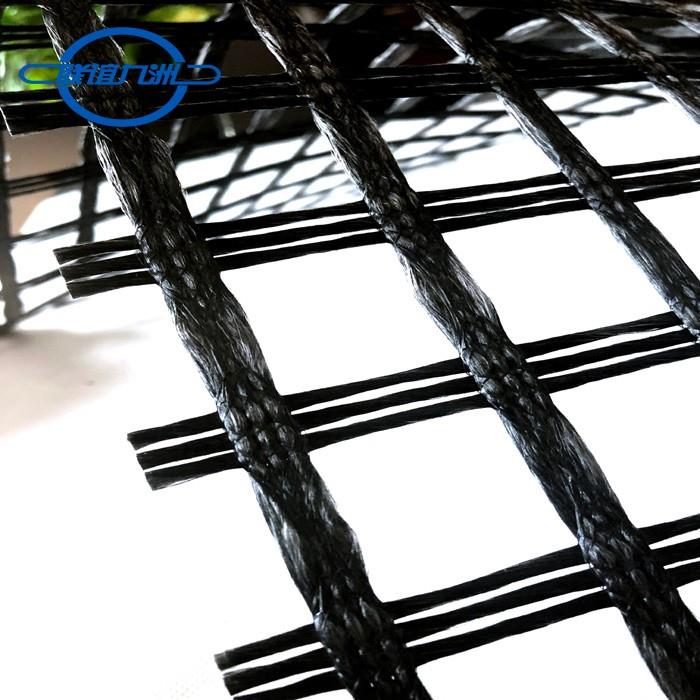

In road construction, PET Geogrid can be used to reinforce asphalt pavements. By placing the geogrid between the base and the asphalt layer, it can distribute the load more evenly, reduce cracking, and extend the service life of the road. You can learn more about Polyester Geogrid for Retaining Wall.
PET Geogrid is also used in landfill construction. It can be used to reinforce the liner system, preventing the liner from puncturing and improving the overall stability of the landfill.
Conclusion
In conclusion, the manufacturing process of PET Geogrid involves several complex steps, from raw material selection to quality control. Each step is crucial in ensuring that the final product has the desired properties and meets the high - quality standards required for various civil engineering applications.
As a supplier of PET Geogrid, we are committed to providing our customers with the highest - quality products. Our state - of - the - art manufacturing facilities and strict quality control measures ensure that every roll of geogrid we produce is of the best quality.
If you are interested in purchasing PET Geogrid for your construction projects, we invite you to contact us for further information and to discuss your specific requirements. We look forward to working with you and providing you with the best geogrid solutions for your needs.
References
- Koerner, R. M. (2012). Designing with Geosynthetics. Pearson.
- ASTM International. (2020). ASTM standards related to geogrids for civil engineering applications.