


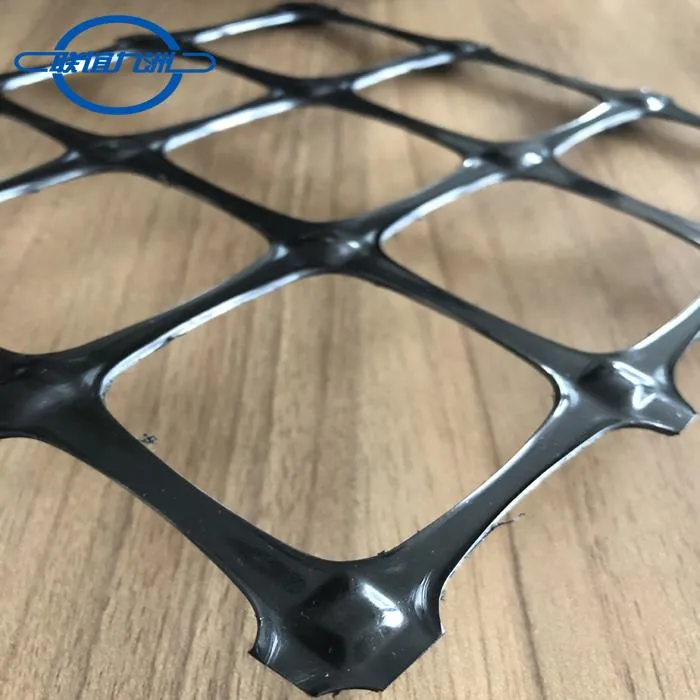
As a supplier of Plastic Biaxial Geogrid, I've witnessed firsthand the critical role this product plays in various construction and engineering projects. However, one of the challenges often faced is enhancing its UV - resistance. In this blog, I'll share some effective strategies based on my years of experience in the industry.
Understanding the Impact of UV Radiation on Plastic Biaxial Geogrid
Before delving into the ways to enhance UV - resistance, it's essential to understand how UV radiation affects plastic biaxial geogrids. UV rays from the sun can cause a phenomenon known as photo - oxidation in plastics. This process breaks down the polymer chains in the geogrid, leading to a reduction in its mechanical properties such as tensile strength and elongation at break. Over time, the geogrid may become brittle, cracked, and lose its ability to provide the necessary reinforcement for soil stabilization.
Incorporating UV Stabilizers
One of the most common and effective methods to enhance the UV - resistance of plastic biaxial geogrid is by incorporating UV stabilizers during the manufacturing process. UV stabilizers can be classified into two main types: UV absorbers and hindered amine light stabilizers (HALS).
UV absorbers work by absorbing the UV radiation and converting it into heat, which is then dissipated. They act as a shield, preventing the UV rays from reaching the polymer chains in the geogrid. Examples of UV absorbers include benzotriazoles and benzophenones. These chemicals are typically added in small quantities during the extrusion process of the geogrid.
HALS, on the other hand, function by scavenging the free radicals generated during photo - oxidation. Free radicals are highly reactive molecules that can cause damage to the polymer chains. By neutralizing these free radicals, HALS help to prevent the degradation of the geogrid. HALS are known for their long - term effectiveness and are often used in combination with UV absorbers to provide comprehensive UV protection.
Surface Treatments
Another approach to enhancing UV - resistance is through surface treatments. One such treatment is the application of a protective coating on the geogrid. The coating can act as a physical barrier, blocking the UV rays from reaching the underlying plastic material.
A common type of coating is a pigmented coating. Pigments can absorb and scatter UV radiation, reducing its impact on the geogrid. For example, carbon black is a widely used pigment in geogrid coatings. It not only provides excellent UV protection but also enhances the overall durability of the geogrid.
In addition to pigmented coatings, there are also clear coatings available that can provide UV protection without altering the appearance of the geogrid significantly. These clear coatings often contain UV - blocking agents and can be applied through processes such as spraying or dipping.
Material Selection
The choice of plastic material used in the manufacturing of the biaxial geogrid also plays a crucial role in its UV - resistance. Some plastics are inherently more resistant to UV radiation than others.
Polypropylene (PP) is a commonly used material for biaxial geogrids. It has good mechanical properties and is relatively cost - effective. However, pure polypropylene is not very resistant to UV radiation. To improve its UV - resistance, it can be modified with additives or blended with other polymers.
High - density polyethylene (HDPE) is another option. HDPE has better UV - resistance compared to polypropylene, especially when it is properly formulated with UV stabilizers. It also has excellent chemical resistance and low moisture absorption, making it suitable for a wide range of environmental conditions.
Design Considerations
The design of the plastic biaxial geogrid can also influence its UV - resistance. For example, a thicker geogrid generally has better UV - resistance than a thinner one. This is because the additional material provides more protection against the penetration of UV rays.
The geometry of the geogrid can also play a role. A geogrid with a more open structure may allow more UV radiation to reach the plastic material, while a more closed - cell structure can provide some shielding. Additionally, the spacing between the ribs and apertures of the geogrid can affect its exposure to UV rays.
Quality Control and Testing
To ensure that the plastic biaxial geogrid has the desired level of UV - resistance, rigorous quality control and testing are essential. During the manufacturing process, samples should be regularly tested for UV - resistance using standardized methods.
One common test method is the xenon arc weathering test. In this test, the geogrid samples are exposed to a simulated sunlight environment in a xenon arc chamber. The samples are subjected to cycles of light and moisture to mimic real - world weather conditions. After a specified period of exposure, the samples are evaluated for changes in their mechanical properties, such as tensile strength and elongation at break.
Another test method is the natural weathering test. This involves exposing the geogrid samples outdoors for an extended period, typically several months or even years. The samples are monitored regularly for signs of degradation, such as discoloration, cracking, and loss of strength.
The Importance of UV - Resistant Plastic Biaxial Geogrid
Enhancing the UV - resistance of plastic biaxial geogrid is of utmost importance for its long - term performance in outdoor applications. In road construction, for example, a UV - resistant geogrid can provide long - lasting reinforcement for the subgrade, reducing the risk of pavement failure due to soil settlement.
In slope stabilization projects, a geogrid with good UV - resistance can maintain its integrity over time, preventing soil erosion and landslides. It can also be used in landfill liners, where it needs to withstand the harsh environmental conditions for an extended period.
Conclusion
In conclusion, enhancing the UV - resistance of plastic biaxial geogrid is a multi - faceted process that involves material selection, the use of UV stabilizers, surface treatments, design considerations, and quality control. By implementing these strategies, we can ensure that the geogrid has the necessary durability to withstand the long - term effects of UV radiation.
If you are in need of high - quality Biaxial Plastic Geogrid with excellent UV - resistance for your construction or engineering project, feel free to reach out. Our team of experts is always ready to assist you in selecting the right product and providing technical support. We also offer Plastic Biaxial Geogrid and Biaxial Geogrid that meet the highest industry standards. Contact us today to start a discussion about your specific requirements and how we can help you achieve your project goals.

References
- ASTM D4355 - 99(2018). Standard Practice for Extruded Uniaxial and Biaxial Polymeric Geogrids for Soil Reinforcement.
- "Plastic Additives Handbook" by Hans Zweifel.
- ISO 4892 - 2:2013. Plastics — Methods of exposure to laboratory light sources — Part 2: Xenon - arc lamps.