


As a supplier of PP Non Woven Geotextile, I've often been asked about the dimensional stability of our products. Dimensional stability is a crucial property in geotextiles, as it determines how well the material maintains its shape and size under various environmental and mechanical stresses. In this blog, I'll delve into the factors that affect the dimensional stability of PP Non Woven Geotextile and explain why our products offer excellent performance in this regard.
Understanding Dimensional Stability in Geotextiles
Dimensional stability refers to the ability of a material to resist changes in its dimensions, such as length, width, and thickness, when subjected to external forces or environmental conditions. In the context of geotextiles, these forces can include mechanical stress from soil movement, installation, and traffic loads, as well as environmental factors like temperature variations, moisture, and chemical exposure.
A geotextile with poor dimensional stability may stretch, shrink, or deform over time, which can compromise its performance in applications such as soil reinforcement, erosion control, and filtration. On the other hand, a geotextile with good dimensional stability will maintain its integrity and functionality, providing long - term reliability in geotechnical projects.
Factors Affecting the Dimensional Stability of PP Non Woven Geotextile
Material Properties
Polypropylene (PP) is the primary material used in our non - woven geotextiles. Polypropylene has several inherent properties that contribute to good dimensional stability. Firstly, it has a relatively low coefficient of thermal expansion. This means that it expands and contracts less than many other polymers when exposed to temperature changes. For example, in regions with large temperature fluctuations between day and night or across seasons, a PP Non Woven Geotextile will not experience significant size changes, ensuring that it remains firmly in place and continues to perform its intended function.
Secondly, polypropylene is resistant to moisture absorption. Water can cause many materials to swell or deform, but PP's hydrophobic nature prevents this. When used in applications where the geotextile may come into contact with water, such as in drainage systems or wetland restoration projects, it will not lose its shape or strength due to moisture uptake.

Manufacturing Process
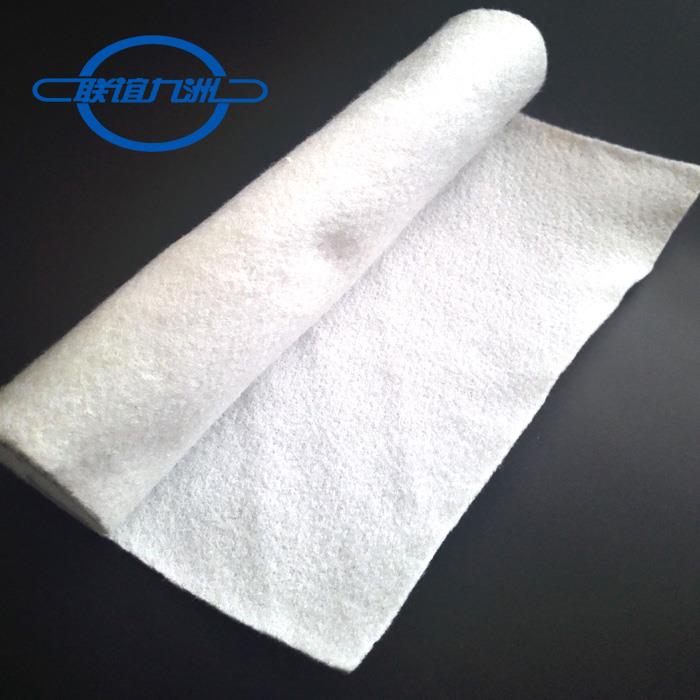
The manufacturing process of PP Non Woven Geotextile also plays a vital role in its dimensional stability. Our PP Needle Punched Nonwoven Geotextile is produced using a needle punching technique. This process involves mechanically interlocking the polypropylene fibers to create a strong and stable structure. The needles penetrate the fiber web, entangling the fibers and forming a cohesive fabric. This interlocking of fibers resists stretching and deformation, enhancing the overall dimensional stability of the geotextile.
In addition, during the manufacturing process, we carefully control the fiber orientation and density. A uniform fiber distribution and appropriate density ensure that the geotextile has consistent properties across its entire surface. This uniformity helps to prevent localized stretching or shrinking, which could lead to dimensional instability.
Mechanical Stress Resistance
PP Non Woven Geotextiles are designed to withstand mechanical stresses during installation and in service. When installed in soil, they may be subjected to forces such as pulling, pushing, and shearing. Our geotextiles have high tensile strength, which allows them to resist stretching under these forces. For example, in soil reinforcement applications, the geotextile is used to distribute loads and prevent soil movement. A geotextile with good dimensional stability will not elongate excessively under the applied loads, maintaining its effectiveness in stabilizing the soil.
Moreover, our 12 Oz Non Woven Geotextile is engineered to have excellent puncture and tear resistance. This is important because any damage to the geotextile can lead to a loss of dimensional stability. By being able to resist punctures and tears from sharp objects in the soil or during installation, the geotextile can maintain its shape and integrity.
Testing and Quality Assurance
To ensure the dimensional stability of our PP Non Woven Geotextiles, we conduct a series of rigorous tests. These tests simulate real - world conditions to evaluate how the geotextile will perform over time.
Thermal Testing
We subject our geotextiles to temperature cycling tests, where they are exposed to a range of temperatures from extremely cold to hot. After each cycle, we measure the dimensional changes of the geotextile. Our products consistently show minimal changes in length and width, indicating their excellent thermal stability.
Moisture Testing
Moisture tests involve soaking the geotextile in water for a specified period and then measuring any changes in dimensions. Our polypropylene geotextiles show no significant swelling or shrinkage, confirming their resistance to moisture - induced dimensional changes.
Mechanical Testing
Tensile strength tests are performed to measure the geotextile's ability to resist stretching. We also conduct puncture and tear tests to assess its durability under mechanical stress. These tests ensure that our geotextiles can maintain their shape and size even when subjected to harsh installation and service conditions.
Applications Benefiting from Dimensional Stability
The good dimensional stability of our PP Non Woven Geotextiles makes them suitable for a wide range of applications.
Road Construction
In road construction, geotextiles are used for soil reinforcement and separation. A geotextile with good dimensional stability can effectively distribute the loads from traffic, preventing the subgrade soil from migrating into the aggregate layer. This helps to extend the lifespan of the road and reduce maintenance costs. Our Polypropylene Non Woven Geotextile remains stable under the heavy traffic loads, ensuring long - term performance.
Erosion Control
For erosion control on slopes and embankments, dimensional stability is crucial. The geotextile must stay in place to prevent soil erosion by water or wind. Our PP Non Woven Geotextiles, with their resistance to stretching and deformation, can firmly anchor the soil and protect it from erosion, even in challenging environmental conditions.
Landfill Liners
In landfill applications, geotextiles are used as part of the liner system to prevent the leakage of leachate. A geotextile with good dimensional stability will maintain its integrity over time, providing a reliable barrier against the escape of contaminants.
Conclusion
In conclusion, PP Non Woven Geotextiles have excellent dimensional stability due to the inherent properties of polypropylene, the advanced manufacturing process, and rigorous quality control. Our products are designed and tested to withstand a variety of environmental and mechanical stresses, ensuring long - term performance in a wide range of geotechnical applications.
If you are involved in a geotechnical project and are looking for a reliable geotextile solution, our PP Non Woven Geotextiles are an ideal choice. We are committed to providing high - quality products that meet your specific requirements. Contact us to discuss your project needs and explore how our geotextiles can contribute to the success of your project.
References
- Koerner, R. M. (2012). Designing with Geosynthetics. Pearson.
- Giroud, J. P., & Bonaparte, R. (1989). Design and construction guidelines for geotextile - reinforced unpaved roads. Journal of Geotechnical Engineering, 115(11), 1542 - 1564.
- ASTM International. (2019). Standard test methods for nonwoven geotextiles. ASTM D4354 - 19.