


In the realm of railway construction, materials play a pivotal role in ensuring the stability, durability, and safety of the tracks. One such material that has gained significant traction in recent years is the Biaxial Plastic Geogrid. As a seasoned supplier of Biaxial Plastic Geogrids, I've witnessed firsthand the transformative impact these products have on railway projects. In this blog, I'll delve into the various functions of Biaxial Plastic Geogrid in railway construction and why it's an indispensable component for modern railway infrastructure.
Reinforcement of Railway Subgrade
The subgrade is the foundation upon which the railway track is laid. It bears the weight of the trains, the tracks, and the ballast. Any instability in the subgrade can lead to track deformation, uneven settlement, and ultimately, safety hazards. Biaxial Plastic Geogrid acts as a reinforcement material for the subgrade, enhancing its strength and stability.
The geogrid's unique biaxial structure provides high tensile strength in both the longitudinal and transverse directions. When installed in the subgrade, it distributes the load more evenly across a larger area, reducing the stress concentration on the soil. This helps to prevent soil displacement and lateral spreading, which are common causes of subgrade failure.
For example, in areas with soft or weak soils, the use of Biaxial Plastic Geogrid can significantly improve the bearing capacity of the subgrade. By interlocking with the soil particles, the geogrid creates a composite structure that can resist the forces exerted by the trains. This not only extends the lifespan of the railway but also reduces the need for frequent maintenance and repairs.
Separation of Layers
Another important function of Biaxial Plastic Geogrid in railway construction is to separate different layers of materials. In a typical railway track system, there are multiple layers, including the subgrade, the sub - ballast, and the ballast. Without proper separation, these layers can mix over time, leading to a decrease in the overall performance of the track.
The geogrid acts as a physical barrier between the layers, preventing the intermixing of soil and ballast. This ensures that each layer retains its intended properties and functions. For instance, the ballast layer provides drainage and support for the tracks. If the ballast mixes with the underlying soil, its drainage capacity will be reduced, and the support for the tracks will be compromised. The Biaxial Plastic Geogrid keeps the ballast and soil layers separate, maintaining the integrity of the track structure.
Stabilization of Ballast
The ballast layer is crucial for the proper functioning of a railway track. It provides a stable base for the tracks, distributes the load from the trains, and allows for drainage. However, under the repeated loading of trains, the ballast particles can become displaced and degraded over time.
Biaxial Plastic Geogrid helps to stabilize the ballast by confining the ballast particles within its apertures. The geogrid's structure restricts the movement of the ballast, reducing the lateral displacement and breakage of the particles. This results in a more stable ballast layer, which can better withstand the dynamic loads of the trains.

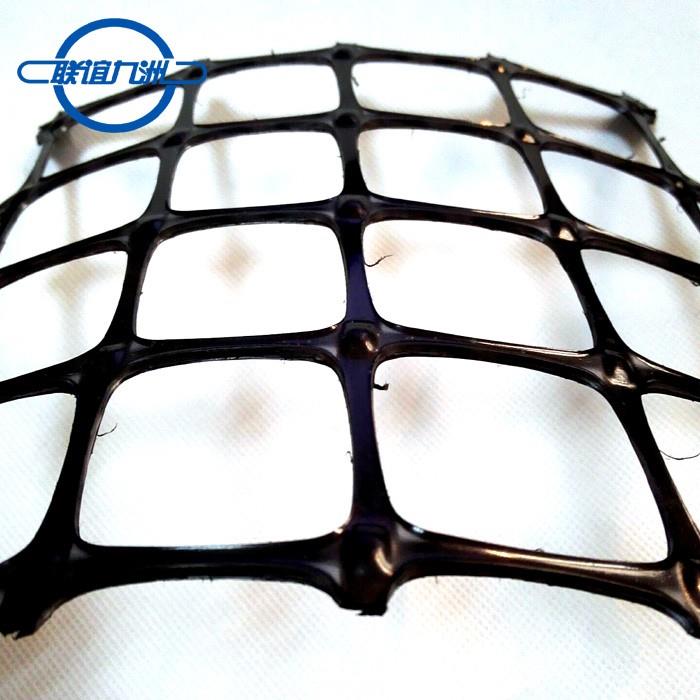
Moreover, the use of Biaxial Plastic Geogrid in the ballast layer can also improve the track's resistance to frost heave. In cold climates, the freezing and thawing of water in the soil can cause the track to heave, leading to uneven track surfaces. The geogrid helps to distribute the forces associated with frost heave more evenly, reducing the impact on the track.
Erosion Control
Railway embankments are often exposed to natural elements such as rain, wind, and water flow. Erosion of the embankment can undermine the stability of the railway track and pose a significant safety risk. Biaxial Plastic Geogrid can be used as an erosion control measure on railway embankments.
When installed on the surface of the embankment, the geogrid provides a protective layer that anchors the soil and prevents it from being washed away by water or blown away by wind. The geogrid's open - mesh structure allows for vegetation growth, which further enhances the erosion control effect. The roots of the plants interlock with the geogrid and the soil, creating a more stable and erosion - resistant surface.
Cost - Effectiveness
In addition to its technical functions, Biaxial Plastic Geogrid is also a cost - effective solution for railway construction. Compared to traditional methods of subgrade reinforcement and stabilization, such as using large amounts of fill materials or deep foundation systems, the use of geogrid is more economical.
The geogrid is lightweight, easy to install, and requires less labor and equipment. This reduces the construction time and cost. Moreover, its long - term durability means that it can reduce the maintenance and replacement costs over the lifespan of the railway.
Product Recommendations
As a Biaxial Plastic Geogrid supplier, I would like to recommend some of our popular products for railway construction. The PP Biaxial Geogrid BX1200 offers high tensile strength and is suitable for heavy - duty railway projects. The PP Biaxial Geogrid 40kn provides a good balance between strength and cost, making it a versatile option for various railway applications. And for projects with less demanding requirements, the PP Biaxial Geogrid 20kn can be a cost - effective choice.
Conclusion
In conclusion, Biaxial Plastic Geogrid is a multifunctional material that plays a crucial role in railway construction. Its functions in subgrade reinforcement, layer separation, ballast stabilization, erosion control, and cost - effectiveness make it an essential component for modern railway infrastructure.
If you're involved in a railway construction project and are considering the use of Biaxial Plastic Geogrid, I encourage you to reach out to discuss your specific needs. We have a team of experts who can provide you with professional advice and solutions tailored to your project. Whether you need a small - scale supply or a large - scale project implementation, we're committed to meeting your requirements and ensuring the success of your railway project.
References
- Allen, D. M., & Bathurst, R. J. (1996). Geosynthetic - reinforced soil design. CRC Press.
- Koerner, R. M. (2012). Designing with geosynthetics. Pearson.
- Mitchell, J. K. (1993). Fundamentals of soil behavior. Wiley.